

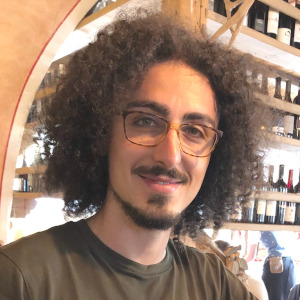
Junior Researcher
Research Interests:
Quantum Information; Open Quantum systems; Models of wave function collapse related to gravity
Personal website:
www.qmts.it
Selected publications:
Crognaletti, G; Bartolomeo, Giovanni Di; Vischi, M; Viteritti, LL
Equivariant Variational Quantum Eigensolver to detect phase transitions through energy level crossings Journal Article
In: Quantum Sci. Technol., vol. 10, no. 1, 2025, ISSN: 2058-9565.
@article{Crognaletti2024,

title = {Equivariant Variational Quantum Eigensolver to detect phase transitions through energy level crossings},

author = {G Crognaletti and Giovanni Di Bartolomeo and M Vischi and LL Viteritti},

doi = {10.1088/2058-9565/ad9be3},

issn = {2058-9565},

year  = {2025},

date = {2025-01-01},

urldate = {2025-01-01},

journal = {Quantum Sci. Technol.},

volume = {10},

number = {1},

publisher = {IOP Publishing},

abstract = {<jats:title>Abstract</jats:title>

               <jats:p>Level spectroscopy stands as a powerful method for identifying the transition point that delineates distinct quantum phases. Since each quantum phase exhibits a characteristic sequence of excited states, the crossing of energy levels between low-lying excited states offers a reliable mean to estimate the phase transition point. While approaches like the Variational Quantum Eigensolver are useful for approximating ground states of interacting systems using quantum computing, capturing low-energy excitations remains challenging. In our study, we introduce an equivariant quantum circuit that preserves the total spin and the translational symmetry to accurately describe singlet and triplet excited states in the <jats:italic>J</jats:italic>

                  <jats:sub>1</jats:sub>–<jats:italic>J</jats:italic>

                  <jats:sub>2</jats:sub> Heisenberg model on a chain, which are crucial for characterizing its transition point. Additionally, we assess the impact of noise on the variational state, showing that conventional mitigation techniques like Zero Noise Extrapolation reliably restore its physical properties.</jats:p>},

keywords = {},

pubstate = {published},

tppubtype = {article}

}
<jats:p>Level spectroscopy stands as a powerful method for identifying the transition point that delineates distinct quantum phases. Since each quantum phase exhibits a characteristic sequence of excited states, the crossing of energy levels between low-lying excited states offers a reliable mean to estimate the phase transition point. While approaches like the Variational Quantum Eigensolver are useful for approximating ground states of interacting systems using quantum computing, capturing low-energy excitations remains challenging. In our study, we introduce an equivariant quantum circuit that preserves the total spin and the translational symmetry to accurately describe singlet and triplet excited states in the <jats:italic>J</jats:italic>
<jats:sub>1</jats:sub>–<jats:italic>J</jats:italic>
<jats:sub>2</jats:sub> Heisenberg model on a chain, which are crucial for characterizing its transition point. Additionally, we assess the impact of noise on the variational state, showing that conventional mitigation techniques like Zero Noise Extrapolation reliably restore its physical properties.</jats:p>
Bartolomeo, Giovanni Di; Carlesso, M
Experimental bounds on linear-friction dissipative collapse models from levitated optomechanics Journal Article
In: New J. Phys., vol. 26, no. 4, 2024, ISSN: 1367-2630.
@article{DiBartolomeo2024,

title = {Experimental bounds on linear-friction dissipative collapse models from levitated optomechanics},

author = {Giovanni Di Bartolomeo and M Carlesso},

doi = {10.1088/1367-2630/ad3842},

issn = {1367-2630},

year  = {2024},

date = {2024-04-01},

urldate = {2024-04-01},

journal = {New J. Phys.},

volume = {26},

number = {4},

publisher = {IOP Publishing},

abstract = {<jats:title>Abstract</jats:title>

               <jats:p>Collapse models constitute an alternative to quantum mechanics that solve the well-know quantum measurement problem. In this framework, a novel approach to include dissipation in collapse models has been recently proposed, and awaits experimental scrutiny. Our work establishes experimental bounds on the so-constructed linear-friction dissipative Diósi-Penrose (dDP) and Continuous Spontaneous localisation (dCSL) models by exploiting experiments in the field of levitated optomechanics. Our results in the dDP case exclude collapse temperatures below 10<jats:sup>−13</jats:sup> K and <jats:inline-formula>

                     <jats:tex-math/>

                     <mml:math xmlns:mml="http://www.w3.org/1998/Math/MathML" overflow="scroll">

                        <mml:mrow>

                           <mml:mn>6</mml:mn>

                           <mml:mo>×</mml:mo>

                           <mml:msup>

                              <mml:mn>10</mml:mn>

                              <mml:mrow>

                                 <mml:mo>−</mml:mo>

                                 <mml:mn>12</mml:mn>

                              </mml:mrow>

                           </mml:msup>

                        </mml:mrow>

                     </mml:math>

                     <jats:inline-graphic xmlns:xlink="http://www.w3.org/1999/xlink" xlink:href="njpad3842ieqn1.gif" xlink:type="simple"/>

                  </jats:inline-formula> K respectively for values of the localisation length smaller than 10<jats:sup>−6</jats:sup> m and 10<jats:sup>−8</jats:sup> m. In the dCSL case the entire parameter space is excluded for values of the temperature lower than <jats:inline-formula>

                     <jats:tex-math/>

                     <mml:math xmlns:mml="http://www.w3.org/1998/Math/MathML" overflow="scroll">

                        <mml:mrow>

                           <mml:mn>6</mml:mn>

                           <mml:mo>×</mml:mo>

                           <mml:msup>

                              <mml:mn>10</mml:mn>

                              <mml:mrow>

                                 <mml:mo>−</mml:mo>

                                 <mml:mn>9</mml:mn>

                              </mml:mrow>

                           </mml:msup>

                        </mml:mrow>

                     </mml:math>

                     <jats:inline-graphic xmlns:xlink="http://www.w3.org/1999/xlink" xlink:href="njpad3842ieqn2.gif" xlink:type="simple"/>

                  </jats:inline-formula> K.</jats:p>},

keywords = {},

pubstate = {published},

tppubtype = {article}

}
<jats:p>Collapse models constitute an alternative to quantum mechanics that solve the well-know quantum measurement problem. In this framework, a novel approach to include dissipation in collapse models has been recently proposed, and awaits experimental scrutiny. Our work establishes experimental bounds on the so-constructed linear-friction dissipative Diósi-Penrose (dDP) and Continuous Spontaneous localisation (dCSL) models by exploiting experiments in the field of levitated optomechanics. Our results in the dDP case exclude collapse temperatures below 10<jats:sup>−13</jats:sup> K and <jats:inline-formula>
<jats:tex-math/>
<mml:math xmlns:mml="http://www.w3.org/1998/Math/MathML" overflow="scroll">
<mml:mrow>
<mml:mn>6</mml:mn>
<mml:mo>×</mml:mo>
<mml:msup>
<mml:mn>10</mml:mn>
<mml:mrow>
<mml:mo>−</mml:mo>
<mml:mn>12</mml:mn>
</mml:mrow>
</mml:msup>
</mml:mrow>
</mml:math>
<jats:inline-graphic xmlns:xlink="http://www.w3.org/1999/xlink" xlink:href="njpad3842ieqn1.gif" xlink:type="simple"/>
</jats:inline-formula> K respectively for values of the localisation length smaller than 10<jats:sup>−6</jats:sup> m and 10<jats:sup>−8</jats:sup> m. In the dCSL case the entire parameter space is excluded for values of the temperature lower than <jats:inline-formula>
<jats:tex-math/>
<mml:math xmlns:mml="http://www.w3.org/1998/Math/MathML" overflow="scroll">
<mml:mrow>
<mml:mn>6</mml:mn>
<mml:mo>×</mml:mo>
<mml:msup>
<mml:mn>10</mml:mn>
<mml:mrow>
<mml:mo>−</mml:mo>
<mml:mn>9</mml:mn>
</mml:mrow>
</mml:msup>
</mml:mrow>
</mml:math>
<jats:inline-graphic xmlns:xlink="http://www.w3.org/1999/xlink" xlink:href="njpad3842ieqn2.gif" xlink:type="simple"/>
</jats:inline-formula> K.</jats:p>
Bartolomeo, Giovanni Di; Carlesso, M; Piscicchia, K; Curceanu, C; Derakhshani, M; Diósi, L
Linear-friction many-body equation for dissipative spontaneous wave-function collapse Journal Article
In: Phys. Rev. A, vol. 108, no. 1, 2023, ISSN: 2469-9934.
@article{DiBartolomeo2023b,

title = {Linear-friction many-body equation for dissipative spontaneous wave-function collapse},

author = {Giovanni Di Bartolomeo and M Carlesso and K Piscicchia and C Curceanu and M Derakhshani and L Diósi},

doi = {10.1103/physreva.108.012202},

issn = {2469-9934},

journal = {Phys. Rev. A},

volume = {108},

number = {1},

publisher = {American Physical Society (APS)},

keywords = {},

pubstate = {published},

tppubtype = {article}

}
Bartolomeo, Giovanni Di; Vischi, M; Cesa, F; Wixinger, R; Grossi, M; Donadi, S; Bassi, A
Noisy gates for simulating quantum computers Journal Article
In: Phys. Rev. Research, vol. 5, no. 4, 2023, ISSN: 2643-1564.
@article{DiBartolomeo2023,

title = {Noisy gates for simulating quantum computers},

author = {Giovanni Di Bartolomeo and M Vischi and F Cesa and R Wixinger and M Grossi and S Donadi and A Bassi},

doi = {10.1103/physrevresearch.5.043210},

issn = {2643-1564},

journal = {Phys. Rev. Research},

volume = {5},

number = {4},

publisher = {American Physical Society (APS)},

keywords = {},

pubstate = {published},

tppubtype = {article}

}
Bartolomeo, Giovanni Di; Vischi, M; Feri, T; Bassi, A; Donadi, S
Efficient quantum algorithm to simulate open systems through a single environmental qubit Journal Article
In: Phys. Rev. Research, vol. 6, no. 4, 2024, ISSN: 2643-1564.
@article{DiBartolomeo2024b,

title = {Efficient quantum algorithm to simulate open systems through a single environmental qubit},

author = {Giovanni Di Bartolomeo and M Vischi and T Feri and A Bassi and S Donadi},

doi = {10.1103/physrevresearch.6.043321},

issn = {2643-1564},

journal = {Phys. Rev. Research},

volume = {6},

number = {4},

publisher = {American Physical Society (APS)},

abstract = {<jats:p>We present an efficient algorithm for simulating open quantum systems dynamics described by the Lindblad master equation on quantum computers, addressing key challenges in the field. In contrast to existing approaches, our method achieves two significant advancements. First, we employ a repetition of unitary gates on a set of <a:math xmlns:a="http://www.w3.org/1998/Math/MathML"><a:mi>n</a:mi></a:math> system qubits and, remarkably, only a single ancillary bath qubit representing the environment. It follows that, for the typical case of <b:math xmlns:b="http://www.w3.org/1998/Math/MathML"><b:mi>m</b:mi></b:math> locality of the Lindblad operators, we reach an exponential improvement of the number of ancilla in terms of <c:math xmlns:c="http://www.w3.org/1998/Math/MathML"><c:mi>m</c:mi></c:math> and up to a polynomial improvement in ancilla overhead for large <d:math xmlns:d="http://www.w3.org/1998/Math/MathML"><d:mi>n</d:mi></d:math> with respect to other approaches. Although stochasticity is introduced, requiring multiple circuit realizations, the sampling overhead is independent of the system size. Second, we show that, under fixed accuracy conditions, our algorithm enables a reduction in the number of Trotter steps compared to other approaches, substantially decreasing circuit depth. These advancements hold particular significance for near-term quantum computers, where minimizing both width and depth is critical due to inherent noise in their dynamics.</jats:p>

          <jats:sec>

            <jats:title/>

            <jats:supplementary-material>

              <jats:permissions>

                <jats:copyright-statement>Published by the American Physical Society</jats:copyright-statement>

                <jats:copyright-year>2024</jats:copyright-year>

              </jats:permissions>

            </jats:supplementary-material>

          </jats:sec>},

keywords = {},

pubstate = {published},

tppubtype = {article}

}
<jats:sec>
<jats:title/>
<jats:supplementary-material>
<jats:permissions>
<jats:copyright-statement>Published by the American Physical Society</jats:copyright-statement>
<jats:copyright-year>2024</jats:copyright-year>
</jats:permissions>
</jats:supplementary-material>
</jats:sec>
Biography
Graduated in Physics at the University of Rome "La Sapienza" (2021). He is currently a PhD student at the University of Trieste